Friday, February 03, 2012

WERE IS THE MAKIWARA: My hands Cry out for the punishment.


WERE IS THE MAKIWARA: My hands Cry out for the punishment.


This is not some macho post that will say how tough I am, actually it’s a post on the self-inflicted Silliness that I have become addicted to! When I was a kid starting out in Karate the idea of hitting a wooden block set in the ground was something that made me giggle, like “what kind of moron does that”! I started off in Karate and despite being in lots of brush ups the idea of punching someone in the face…without being mad at them…well it made me pause and wonder “who does that”.


Fast forwards to my late teens and I began using the Makiwara, even if Dingman Sensei did not really want us hitting it really hard. I began to do it because it was “cool” to wack the board and make it go “thump” when you hit it. I watched my seniors and copied them. Each punch was solid and more and more solid. I liked hitting the rubber mat that was tacked onto the Makiwara and it became second nature to me.


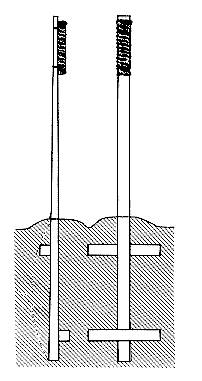
Then, in my mid to late 20’s one of my seniors brought back real Makiwara Rice stalk cover and we started all over again hitting a new surface. At first it BIT hard into the flesh and you felt like your hand was getting ripped up each time you struck it. But after a while My hands got used to it. I would do 200-500 strikes before the noon class, and probably about as many before the evening class. I started getting a big callas on my knuckles and while I thought it looked cool, I also just liked the act of working on my Gyaku zuki with a target.


Hitting things became an obsession for me. I would punch door frames, tiles at work, Concrete walls, never so hard that I would break my hand…but enough to test and punish my hands. I would hit a piece of wood I carried with me that had a rough side….so much that I dented the wood after a few months and had to get a new one.


When I was in school I broke Paraffin wax blocks…much harder to do than it sounds. I broke two by fours with my Gyaku zuki for fun…and even lit one on fire to have a bit more fun. It became a hobby and not something I did often in public. I remember moving into a new house with my mother when I was in university and the first thing I did was take out an auger and put in a new makiwara….one I used A LOT!


As I got older I moved into a small apartment and did not have a makiwara anymore and I missed it, but I always had the one at the club. Soon the club moved and we no longer had one to use. Its been about ten years since I really had a great Makiwara to use and to be honest I mess the punishing work outs that saw my knuckles bleed and lose flesh as well as the feeling of a elastic in the tendon after it had been beaten up a bit.


The reason I miss it however is not some pathological need to do damage to myself, its also not because “it looks cool” to hit something…..I often did most of my Makiwara work in back yards and after or before people got to the Dojo. It was more about the act of studying the techniques and forging my understanding. The reason I miss it…is because it represents a time in my life when I did not have the stresses of being a parent, husband, and adult. It represented a much free’r time in my life when I had the extra time to train and study Karate as a true student. I was not pushed to teach or to be a teacher.


My goals and aspirations revolved around getting into the club, doing Kata and wacking a makiwara. I studied how my hand had to land on someone safely and I loved just training with no pressure. I was a student of the art.


The makiwara will always represent those times to me and my hopes are that I get a new one that I can use in my home. My designs are in and I will hopefully get back to striking the Makiwara in the near future.

Wednesday, February 01, 2012

Splitting Heirs! : JKA and the big splits


I have been asked on more than one occasion to describe the fracturing of the JKA world organization and try to explain the separations and splits. I have been asked to explain why this happened and what caused them…to be frank, I don’t often feel comfortable talking about the splits. The truth is that the JKA has been a home to me on and off for almost 35 years and I have had a great amount of respect for all the instructors I have trained with.
Most of the splits represent dirty laundry…one person feeling they are entitled to certain things and then getting upset and I see it as stamping your feet and picking up your ball to go home. Often I see the splitting people as grown men acting as children. But some of the fractures were its timing and the situation called for a new group to be formed.
I am also acutely aware of people who are “ANTI-ORGANIZATION” and also “ANTI-JKA” to them…I say grow up. Lets face it I was not personally involved in any of the splits that I am going to talk about and if you don’t respect Ueki Sensei, Kanazawa Sensei, Yahara Sensei, Asai Sensei or the rest for their contributions to Karate…well I have little time for small minded morons! So, as gingerly as I can I will try to explain a few of the splits, fractures and rebirths as I can. Keep in mind that I mean no disrespect to any groups I mention, don’t mention or even don’t know about. I am simply going on what I can and what I know.
Also, I try to keep all personal issues I may have with some groups to myself. I don’t like to speak ill of some groups because I simply don’t agree with their stance, we don’t interact and the world is a rather large place, I am sure I can avoid “accidentally” Showing up at a seminar or camp that has some people at them. Besides Training and time heal most wounds!
One key factor to keep in mind, at the highest level of the splits, the chief instructors…they all get along if put in a room, why cant their zealous followers….Point of fact, One ISKF Sensei once told me of the heretic (my words…in jest…partially) Kanazawa and how he felt his ideas were not for him or his students. How Kanazawa was “given the boot” because he had “Different ideas”. Fast forward two decades and who is teaching at the ISKF Camp…Kanazawa…IF that does not speak volumes…well I don’t know what does!

Splitting Heirs! : JKA and the big splits

The Japan Karate Association was formed in 1949 when Isao Obata, Masatoshi Nakayama and several other students of Funakoshi Sensei banded together to form a organization dedicated to research, promotion, event management and education in Shotokan Karate. Many say that the early JKA was formed in the image of the Kodokan, a Judo organization dedicated to the same ideals as the JKA.
Gichin Funakoshi held the position of founder and essentially the equivalent of Emeritus Chief Instructor, which Nakayama was designated as the chief instructor. Nakayama was a young man with lots of charisma and a solid grasp of scientific principles. With Nakayama’s designation as chief instructor came a rapid growth of Karate in Japan and initiatives to help it grow worldwide.
Many of the senior instructors came from the Takushoku University and had gone on to study in the JKA instructors training program. Perhaps the first big split was when the Shotokai split from the JKA. The Shotokai was made up of many of the university groups other than Takushoku university.


The Shotokai was the original organization formed by Gichin Funakoshi in the 1930’s to promote and teach Karate in the universities. The original name of the group Dai Nihon Karate do Kenkyukai. After the headquarters club was opened the Shotokai began to represent the students in the universities that would do inter club amateur tournaments while the Shotokan, being the headquarters, was seen as more a professional wing of Funakoshi Sensei’s style.
The JKA at the time focused on becoming a legal entity for a professional group. They worked hard and on April 10th 1957 they became a legal entity under the law when they were recognized by the ministry of education as such. No other Karate organization enjoyed this status and it was another 20 years till a Karate organization was recognized by the Japanese government as a legal entity. Two weeks after this occurred, Funakoshi Sensei passed away leaving the JKA as the only professional Karate organization recognized as a legal entity in Japan.

Because of the distinction between the amateur group and the professional group their began to be some cracks in the relationship and just prior to 1957 when Funakoshi sensei passed away the groups separated and were seen as different bodies all together.
There was some friction and even at the masters funeral the flags for the JKA were not allowed, even though many prominent members of the JKA served as pallbearers.
Shotokai was largely influenced by one of Funakoshi Gigo’s students Shigeru Egami. Egami began training under Gigo Funakoshi and was heavily influenced by his early teaching. His ideas of Karate did not include sport or competition and soon the Shotokai left all tournaments and Egami began changing the training even more.
While Shotokai has fundamentally similar basics, the style is much more loose and includes some practices that are very much different from JKA Shotokan. However Shotokai began emphasizing spiritual training over physical training and changing its overall approach to Funakoshis origin art.
The JKA began to grow with Nakayama at the helm. Sensei Nakayama also began to change the Karate that Funakoshi sensei had introduced and the JKA style began to come into clarity as its changes made it more athletic and stronger with more emphasis on explosive power and speed. The JKA grew under Nakayama and his instructor training program and he began to send instructors out to all corners of the world after ensuring they were properly trained.

Tsutomu Oshima traveled to the states in 1955 to continue his university education at UCLA. He held the first known US practice soon after. He had been a member of the Wasada University club from 1948 on and had also received instruction from Sensei Funakoshi and Egami Sensei of the Shotokai. In 1959 he started the Southern California Karate association and opened clubs all over the US’s western states. The organization renamed itself the Shotokan Karate of American in 1969. The SKA was never really part of the JKA but Oshima has had contact and association with the JKA on and off for many years.
Prior to leaving Japan, Funakoshi Sensei awarded Oshima his 5th Dan himself. By his choice Oshima sensei has never requested higher grades be awarded to him. It is also the highest grade that students can attain in the SKA. While never a full member of the JKA his influence in the states has been great and his organization now reaches into several countries as well as being very popular in the US. His own students purchased a plot of land in California overseeing the Pacific ocean and built Oshima a amazing Dojo that is both a great place to train and also a architectural piece of art.

In 1961 a integral member of the JKA left to create his own associated group, and perhaps the first and best known of these groups. Hidetaka Nishiyama left for the states and began teaching and spreading Karate to the US and Pan Am countries. He formed the ITKF (International traditional Karate Federation). Nishiyama organized the ITKF as a result of disagreements he had with the way the World Karate Championships were organized. He passed away in 2008, the ITKF is now run by his former students but has become less of a factor in international Karate and even in North American Karate since his passing a few years ago.

In 1977, the JKA instructor course trained Shiro Asano left the JKA and started the organization now known as the Shotokan Karate-do International federation or the SKIF and invited Hirokazu Kanazawa to start the organization with him. Kanazawa left the JKA and took the lead on the organization. The first split was generated when Kanazawa came to an inpass with the JKA leaders and wanted to change some of the practices that he saw in Karate as well as wanting to form his own sub group. The split was rather harsh and due to Kanazawas unique views he was seen as a bit of a rebel by some and as a renegade by others. Kanazawa has stated that he has merged ideas and practices of Tai chi with his Karate, specifically the idea of flow and other key concepts. However many feel that this evolution is disrespectful of the original art.
Kanazawa and Asano went on to form a large organization and build a strong group in Europe but have never really been as large as the JKA and failed to really reach all the areas that the JKA has reached out to. While Kanazawa and Asano’s split from the JKA was not friendly in any way, it is worth noting that Kanazawa has kept contact with many of his peers and has taught at many summer camps over the years hosted by many of his old friends.

The JKA continued to expand after Kanazawa left, actually growing at an exponential rate. With the success of the Instructor training program, the JKA began to reach out to all countries across the globe and saw great success in north America, Europe, south America and Africa. Nakyama adapted Funakoshi’s approach more over the years and the JKA began to expand and invite more western members to the Honbu Dojo. The JKA continued to grow and expand its organization with few drop offs.
Nakayama and the JKA undertook a world tour that took him across the globe to shore up elegance in the smaller groups and show that the JKA was strong and could continue to develop and grow even further. This is the period that Nakayama Sensei came to Manitoba and gave Dingman Sensei the task of growing JKA Karate in Manitoba and across the Canadian prairies to the west. It was a time of prosperity for all the JKA and a time of growth.

In 1987 Nakayama Sensei passed away without leaving a replacement to his position. He never stated that he would be replaced by one individual and groups started to form that were definitely drawing lines of elegances away from the JKA core group. The JKA itself began having issues inside the Honbu with specific instructors acting as if they were the new leaders of the organization, in fact at this time two distinct JKA groups used the Honbu and the turbulence begin to effect the world JKA groups.
The first group to leave was a European group headed by famed JKA Dojo enforcer Taiji Kase and his Junior Hiroshi Shirai. While the organization was very popular in Europe, they steered clear of North America. After some time Kase began to teach a very unique off shoot of Shotokan to his students and just prior to his passing he formed the Kase-Ha Shotokan Ryu group that eventually changed to the Kase Ryu style after he passed away. The Kase Ryu is known as the Fudokan now and has some very unique Kata that were added by one of his students Vladamir Yorga and Ilija Yorga. While the mainstream Kase group and the group that Shirai now oversees is mainstream JKA with a few changes, the Fudokan has some very non-JKA ideas that make it a very different group.

Next to leave, in the same year, was JKA graduate Taketo Okuda in Brazil. He had formed his own group, the Butoku-Kan and felt it needed his full focus to grow. His style and organization differed greatly from the mainstream but still held its Shotokan roots. Okuda Sensei still maintained some ties to his JKA and quotes his JKA 8th Dan on his web site but he simply wanted to run his South American group on his own.

The biggest split occurred in 1990 when the Asai led group challenged the Nakahara lead JKA group for the right to lead the JKA. A strange and turbulent time was headed by this dispute. As I said it was strange because both groups used the Honbu Dojo to conduct classes and moved along as if they both represented the JKA name at the same time. The legal battle was waged with Nakahara backed group going to court against the Asai group that had also taken many of the young and promising instructors into the organization.
Asai Sensei had been named as Nakayama Senseis replacement as Chief instructor, however the business end of the JKA was led by Nakahara. Nakahara and Asai did not agree on many things and eventually Asai simply opposed the position of Chairman given to Nakahara and took his instructors out of the “mainstream” JKA and formed what is often called the “Matsuno section JKA”.
For 9 years the legal battle between the two groups. Essentially on one side was a very respectable group lead by Nakahara as the president, Suguira as the Chief instructor and masters like Shotokan Stalwart Ueki Sensei and Kumite stand out Tanaka Sensei, Kata expert Osaka….. against JKA Legend Asai, Young kumite stand out Yahara and Kata and kumite king Kagawa leading an equally respectable group on the other side. . Even if it was rather even, the courts saw that the Nakahara group had legal rights to the JKA name and in 1999 awarded the JKA organization to the Nakahara backed group.

Asai sensei along with his students moved out of the JKA and he began teaching under the JKS banner or the Japan Karate Shotorenmei. This group initially included Kagawa Sensei, Keigo Abe sensei and Mikio Yahara, along with the many students and seniors they had initially rallied behind.
Issues soon overcame this faction as well and saw Keigo Abe leave to form his own group (the JSKA) and then Yahara Sensei soon left to form his ultra-traditional KWF, which he saw as a return to traditional values and avoided focusing on tournament training exclusively.

Abe Sensei once held the office of Director of Qualifications at the JKA, however in the split of 1990, he became the technical director of the JKA Matsuno section. Abe was fiercely loyal to his instructor, Nakayam sensei and stated that he saw Nakayama as his only headmaster/chief instructor. When the courts gave the Nakahara based group control of the JKA name he retired from the Matsuno section JKA and left to form his own JSKA group. Renowned as a staunch traditionalist it is said that his Karate organization represents the unchanged style. Abe is also credited for creating the Shobu Ippon style of tournament sparring that most Shotokan students would recognize. Some say he simply headed the team that produced these and others credit him for the creation on his own.

Mikio Yahara was a very talented star in international Karate competitions and a student of both Nakayama Sensei and a junior of Asai Sensei. He was part of the popular tournament world during the height of its popularity. Yahara is often characterized as a Predatory fighter and aggressive with intent! He was also a Kata champion and famous for his Empi and Unsu Kata. Yahara is known to have taken down 34 Local Yakuza and showing up to a tournament with knife wounds on his arms and legs. He left the Nakahara run JKA with Asai Sensei but soon left Asai Sensei after the opposing faction won the court ruling. He formed the Karatenomichi World Federatino with Isaka Akihito after serving under Asai as assistant Chief instructor.
Yahara is also well known for taping and releasing his own 8th Dan examination in 2006. During his exam he was delivering a physical demonstration of his ideas on Karate when he fractured the ribs of his assistant. In 2007 a student and longtime businessman Kenshin Oshima gave Yahara the ShotoKan Dojo in Japan, a 1 billion yen Dojo.

In 1990 the WSKF was formed by Hitoshi Kasuya and Takaeki Kamiyanagi as a global organization. Kasuya had finished the JKA instructor program in 1973 and was a student of Nakayama. Kasuya was heavily influenced by Nakayama sensei and his scientific approach to Karate. He remained with the JKA till the early 1980’s then moved to the SKIF and became a champion in their tournaments. He left and formed the WSKF after retiring from competition.
The WSKF has never been a large organization, nor do they have a huge roster of students. Kasuya and his followers are very loyal to Nakayama however and practice a style that is close to what Nakayama Sensei taught with little changes.

Perhaps the largest split from the Nakahara run JKA group was when the ISKF left the fold. Prior to 2007 Teruyuki Okazaki was one of the most senior Black belts teaching abroad. He was a 9th Dan JKA and had a very strong following in the US and Canada. His organization began to stretch into all regions of the PAN AM area. This split came at a time when the JKA was seeking to shore up its membership and putting in place specific rules to make sure that the organization was strong and each area had one organization to run it, not many. It also hoped to ensure that no one high ranking Karate personality would form sub organizations and undermine their efforts for growth.
Okizaki Sensei had a meeting with his senior instructors and in June he sent a letter of resignation to the JKA along with his most senior instructor Yutaka Yaguchi 7th Dan JKA. As soon as Okizaki announced that the USA had split from the JKA members began to leave the ISKF. Many of the seniors sent resignations to the ISKF and stated they were loyal to the JKA. Senior members like Koyama, Takashina, Mikami and others all stayed with the JKA and began to rebuild the JKA/A.
Okizaki also began to have issues with the Caribbean wing of his organization. As some European groups joined the ISKF and it looked as if the ISKF was going to continue to grow, it also suffered a great loss. Long time loyal student Frank Woon a Tai left the ISKF to form his own organization the IKD. In January of 2011, after a very public and personal disagreement with Okizaki and his other seniors, Frank left with most of the Caribbean, eastern USA and Canadian ISKF groups to form his own organization.

In 2009 Takahashi Sensei of Australia left the JKA to form his own TSKF Australia. The organization was created as a result of some internal issues that Takahashi had with licensing and not wanting to follow the JKA rules. He has since formed a bond and joined the ISKF, however he still apparently runs his organization as he likes as the ISKF is now more “Open door” and from what I gather…he takes full advantage of this and runs his organization as he sees fit.


As you can see, internal troubles…bickering over who has a right to what and licenses, rank and recognition are normally at the forefront of any split. Some people say it all boils down to money. I am not so sure of that. My take is its all power and perception. For instance, when some high ranking instructors leave a group it seems like the first thing they do is get a rank bump and give the same to all their students and supporters. Prime example is Okizaki hitting the glass ceiling level of 9th Dan with the JKA then getting a “student supported” rank bump to 10th Dan, and all his supporters got dragged up several ranks as well.
I am not going to debate if it was warranted or not. Personally if you want to be a 32nd Dan go for it! These men have done so very much for Karate that its not unwarranted for a rank boost in most cases…..but mostly I think its petty and Oshima Sensei has my deepest respect on the issue of Rank at this point!
Now some people just can not get along and other times both sides are fighting for what they think is right. In the case of Asai vs Nakahara, well perhaps it was a personality thing but really, I can see both sides of the coin after a bit of research. Most of the splits happen because one person gets to a point that they have invested so much time and energy into a organization that they feel the split will help them maintain this effort the way they want. And as I suggested before, its often not about money as others suggest.

I hope this points out a history of the splits and does not paint anyone in unduly dark paint. Really I have the utmost respect for all the instructors that have contributed to the JKA style Karate, from those that split before I was born to those that split as recent as last year. I wish that the splits did not happen but to be honest, it has probably improved training today as each instructor is freer to influence styles and training. Don’t think of it as Okizaki Sensei leaving the JKA…think of it as a chance to keep a specific type of Shotokan alive and keep his influence pure, as well as a time for the JKA to shore up the style and ensure that the true JKA style will continue on for a long time to come.

For those that think I was overly harsh to any of these great men and great organizations I say sorry and go back and re-read my blog, Its not that I like one more than the others, I actually hate everyone equally…and like everyone equally. I see the good and the bad in each group and like the place I am at right now. But if I were suddenly out of the JKA and found myself in the KWF,ITKF, SKI or other group….. I am sure I would like the people in that organization as well. After all I am easy to get along with and don’t want to run anything…I just want to be invited to play.

For those that fear I am playing favorites or have not really been around most of these groups, not only do I have a great number of friends in all these groups, I have personally been a member of the ISKF and JKA in the past, independent, trained with SKI members, ITKF members and a huge variety of people from all different groups…and to be honest…they were all very nice and we pretty much all did the same Karate.





Friday, January 27, 2012

Pugilist Dementia


Pugilist Dementia


I have been preaching that contact sports are BAD for you for some time now…even while teaching a combat applicable activity. Let’s face it Karat is not a NO contact activity but it pays a great deal of respect to self-control and control over techniques that can cause a lot of damage. I have also had a lot of students and juniors jump over to more contact oriented sports like Thai boxing and boxing or even more contact oriented Karate styles and while they are having fun, I do warn them a bit about the down falls of getting hit in the melon over and over again…even with protective gear!


Before someone gets upset I am also warning parents about contact sports that have little to do with combat; like Hockey, football and even wrestling. Some of my biggest worries are with bone and soft tissue injuries that lead to permanent damage and injuries that effect the growth of students that partake in these activities. But as of late one thing keeps popping up and as more and more research is done and comes in we have a set of much more destructive issues to keep in mind.


One of the scariest things that have been making news as of late are Dementia Pugilista or DP. It sound rather scary, and for good reason.


DP is a type of neurodegenerative disease classified as Dementia that affects athletes that participate in contact sports that have a lot of high impact blows delivered to the head or the body over all that affect the brain in a whiplash type injury. One way to identify if your sport has a good chance of leading to this issue is if you read a lot about athletes in your sport that suffer from Concussions a lot. The old term for this was Chronic Traumatic Brain injury’s associated with boxing or CTBI-B, or Punch Drunk Syndrome (Punchy).


We used to make fun of the boxers and how slow they were when they got older, kind of like everyone became Rocky or something. But it has been found that 15-20% of amateur boxers will suffer from the condition and it begins to show up 12-16 years after they start their career. Sadly, it’s a major reason that professional boxers have to end their careers early as well.


The condition is not just caused by strikes that land and cause concussions, actually its cased more from strikes that are at the “sub concussive” range or strikes that are landed repeatedly over time that do not cause major knock outs or concussions but build up damage over time.


Because of the damage being found there is a large movement from the medical field to ban the sport in youth and even take it out of the Olympics all together. This means the most prestigious amateur event that includes boxing will no longer be an available for boxers.


So, what causes DP, Loss of neurons, scarring of the brain tissue, alterations of the corpus callosum and other damage to the cerebellum are all implicated in the syndrome. The damage that causes these changes are all related to repeated mild to severe impact injuries and in all the events recorded extended training in impact sports were cited as being reason for this injury and DP to be present.


Some of the actual physical manifestations of this disease are dementia, declining mental ability, problems with memory, parkinsonism, speech problems and explosive behavioral changes that manifest as pathological jealousy, paranoia and rage issues. And in most cases the individual with this type of syndrome are described as “punchy” or “slow”.


Treatments for this disorder are prophylactic in nature only. This means they serve to help mask symptoms and wont reverse them. The use of drugs used in Alzheimer’s and Parkinson’s has proven to assist but not reverse the symptoms.


So why are we just hearing about this issue now…I have no idea. DP was first described back in 1928 by a forensic Pathologist in New Jersey, and again in 1973 when more and more post mortems were done on boxers who suffered with this disorder. The 1973 study used the brains of 15 retired boxers to try and trace a reason for the disorder. The findings concluded that the repeated blows to the head of a boxer cause changes to the brain make up that lead to this disorder and they are irreversible over time. This means that if you stop boxing, even at an early age, the damage that is done…is not going to go away!


Some of the most famous boxers who were found to have suffered from DP are Flyd Patterson, Freddie Roach, Sugar Ray Robinson, Joe Frazier and Muhammad Ali. Now Ali has been diagnosed with Parkinsons, but many feel, including his neurologist that boxing lead to him having this disease as he has no family history of anyone else suffering from this type of neurological disorder.


It is important to also state that a study was done at the Boson University School of Medicine found that when autopsies were done on 11 professional American football players all 11 also showed signs of DP and in one amateur foot ball players case, after a post suicide autopsy was done, he also suffered from depression and paranoia caused by DP. And two professional wrestlers that were Autopsied also had CTE or DP, Chris Benoit and Andrew Martin…Both were done after the wrestlers tragically killed themselves.


DP or CTE are horrible injuries that effect a person physically, mentally and emotionally. It is very important to understand the mechanism and the results of participating in a impact sport that causes repeated injuries to the brain.


A lot of students go off and train at kick boxing clubs and have a great time. They don’t think much of the future and they get beat up a lot training with these clubs. Not everyone is going to suffer from DP because they get punched in the head..but if you had the choice to gamble between taking a art that will relieve stress, help you keep fit, enjoy yourself and one that does all this but might cause you to lose control of your body, become very forgetful, feel paranoid and maybe even at an extreme case kill yourself or those you love because you are paranoid and depressed…what would you put your time into?

Why Basics are so darn important...and how to tell kids this!


Tori no Maki, JudenO ushi and Sukakawa...Or Why basics are so darn important!


Many moons ago, about 15 years ago actually, I had my first full Dojo. I was the only instructor and I was on my own for the better part. I took everything I learned from Dingman Sensei and the other masters I had trained with, sprinkled in some lessons from some of my seniors and set out to try and build a club that would provide great Karate training for all those that came to the club.


For several years I pushed, worked hard, learned valuable lessons about being on my own and teaching and built up a strong program at Sargent park. I had lots of students I was very proud of, one went on to be a regional kick boxing champion, one a doctor and all of them made lives for themselves outside of Karate after the program folded when I had to leave it when Emma was born.


The program was great fun and presented a tone of challenges as a young instructor. One challenge was explaining to people who wanted to be Bruce Lee in three classes why we do so much Kihon and not as much Kumite like other clubs and styles do. First off let me say that this all happened at a time when I was also teaching children’s classes at the summer camp we ran at the JKA.


One of the things I used to use to demonstrate the theory behind the use of Kihon-centric training came from a story I read or was told a long time ago, it was amazing and I have to thank the person who wrote it….But I can not remember who they are. I don’t take credit for the story, just for a few tweeks that I made to it. For those budding young instructors and for those that want to learn why we do Kihon so much…here is the story I use with the kids!


Once upon a time in Old Okinawa was a Sensei who had three students. Two of his three students were well known for their individual skills in Karate, but the third was seen as a bit dull and not very well known. His first student was Tori no Hiko! He was the middle of the students in age and smaller, light and lean. His Karate was all about fast movements, shooting in and out on opponents and using speed to beat his students. He was fast and explosive but very small and never used the Makiwara or did Kata. He loved Kumite and he would dance around spinning and moving like lighting!


His second student was the youngest of his students named Juden O ushi and was big and strong. He would wrestle and lift big rocks all day to prove how strong he was. Kumite with Juden O ushi turned into a wrestling match and he would always twist joint and snap bones on the local bullies. His idea of training was lifting heavy weights and lots of heavy grappling matches, even when his master told him to stick to Kata training.


Sensei Takahara had a third student Sakukawa Kanga. Sakukawa was a medium build student that was not extraordinarily fast, nor was he super strong like Juden O ushi. He was not as well known as the other two students and spent most of his day doing Kihon and Kata. He would do kumite with others but stuck to basic movements and did not show off. At night when Tori no Hiko and Juden O Ushi would go out to the town to drink and show off he would stay at home and practice on his Makiwara or do Kata all night till he did his nightly chores and went to bed.


Takahara Sensei was also the town elder and mayor of the small town. He was tasked with taking care of the village needs including policing and protecting the village and its inhabitants. But Takahara Sensei was getting old and other than teaching Karate and making sure the business of the village was taken care of he asked his students to police the village and protect it. One day a Chinese pirate landed on the coast near the village. He was a cruel and mean man that like to beat on helpless victims and steel their clothing and money. His name was Chan and his attacks on the village became more and more violent and closer to town.


One day Chan ventured into the village and beat up a town elder and stole his good robes and money. The call went to Takahara Sensei to arrest Chan and hand him over to the prefecture authorities to deport him back to China or put him in jail. Takahara Sensei had been told that the much younger pirate was a great fighter from the Ching style of fighting in China, a style that was known for its use of strategy and athletic ability.


Takahara Sensei went to his family Dojo and found his three students all practicing their Karate. He first turned to Tori no Hiko and asked him to go and confront Chan and take him to the castle to be dealt with. Tori no Hiko was ecstatic to be of service and soon left for the village square. He quickly warmed up and called out “CHAN THE PIRATE”, “CHAN THE PIRATE…I CHALLENGE YOU”. Tori no Hiko selected a part of the town square that was moist and soft footing and with plenty of grip for him to use when taking flight during the fight. He also knew that landing hard after jumping would slow him so the ground was perfect for him. He had also waited till dusk to pick his time of attack so the lights of the tavern and stores would distract the eye of an untrained attacker while he jetted around.


Chan came out from behind a building, He had a bundle of expensive robes over his shoulder and was counting coins from a large purse he had tied to his belt. He looked up at the slim fighter before him, dressed in Red robes and said “My, like your robes. We will fight! But If I win I get to keep your robes and money and you will never come back to bother me again or your will be shamed by your dishonesty”!


Tori no Hiko agreed and began tying back his robes to allow him to move more freely. Chan put down his bundle on a rock to keep it out of the dirt and tucked the large purse under the bundle for safe keeping. A large crowd began to form as the two fighters stated the agreed upon rules of the challenge. In Okinawa unarmed challenge duels were common and fights always began with the traditional rules being set out and seconds being agreed upon to make sure the rules were kept while the duel continued. Finally after a short talk the two men took six long paces away from each other and took up their fighting positions.


The fight that followed was explosive and the two men moved around each other throwing out kicks and punches, sweeping each other and rolling around in the mud, jumping up and throwing out punches and kicks. This continued for five minutes while the two men danced around and threw limbs at each other and both landing strikes and kicks that elicited comments from the crowd and drew even more onlookers.


Finally after five exhausting minutes Chan found a hole in Tori no Hikos speed and grabbed ahold of his robe and tossed him to the ground were he grabbed hold of his arm and stretched out his arm till Tori no HIko screamed in pain and said that he gave up.


Chan stood up and let Tori no Hiko up. He said “I am a man of my word”, “If you had won I would have given you back all the clothing and money and went to the authorities happily to be shipped home!”, “but you lost and it is time for you to give up your dirty, but very nice robe and hand over all your money to me”. Tori no Hiko was a man of his word, he shook the dust from his robes, took them off and gave him the few coins he had in his own purse, and dressed only in his underwear he marched off to his masters home to inform him of his loss.


Tori no Hiko had used only his speed and slapping techniques to try to take Chan the pirate in and his strategy was found out and he was bested by the Pirate Chan!


Tori no Hiko came back to the Dojo and told Takahara Sensei he had failed. Takahara Sensei then turned to young Juden O ushi and said “Deshi, Tori no HIko tried to use his speed and failed, it is time to use your strength to bring Chan the Pirate to justice”. With that Juden o Ushi pumped out his chest and said “I will beat that criminal with my Braun and tie him Knots” and he left the Dojo with his chest inflated and his head pushed up to the sky!


Juden O ushi marched out to the village, crossed the river stomping over the foot bridge, past the fields and fruit orchards and past the stores into the center of town. He called out “CHAN THE PIRATE”, “CHAN THE PIRATE…I CHALLENGE YOU”. And at this Chan the pirate came out from the tavern and looked Juden O ushi over. He noticed that Juden O ushi had huge shoulders and a big chest. Chan looked at the large hands and the big forearms that Juden O ushi had and he started to form his strategy for fighting this large wrestler. Juden O ushi was smart, he picked a area of the town square that had hard footing and was dry to help him grip the ground with his feet and not slide. He also selected to attack in the morning hours with the sun at his back to try and blind the defender to his first attacks, which he thought would be all he needed.


The two marched together and while Juden O ushi was much bigger than Chan, he was not much taller. Chan was average build but looked much smaller next to the size of Juden O ushi. The two met face to face and started out the rules of the challenge. Chan noticed that Juden O ushi was wearing a beautiful robe of sky blue with beautiful gold on the arms and he said “My, I like your robes. We will fight! But If I win I get to keep your robes and money and you will never come back to bother me again or your will be shamed by your dishonesty”!


Juden O ushi, at hearing this and thinking that it was pure bravado agreed but said “and WHEN I win you will geive ME all your money and march with me off to the authorities and turn yourself in..and never come back to the village again”. Chan noded in agreement and the two backed off to their starting points. Chan rolled up his rob and tied back the arms, fixed his Obi and took off his Zori (sandles). Juden o uchi mimicked the Chinese pirate and took off his Zori and tied back his robe. He retired his Chonmage (top knot), one that he wore in the style of a Oichi (sumo style top knot)and began getting ready for his fight.


Juden O ushi began warming up and stomping on the ground, he took up a hand full of sandy dirt and wrung his hands in the dirt. He formed a deep Shiko dachi and slapped his legs and body. The muscles rippled and he grunted with his efforts. And with each stomp the very ground shook. The crowd held their breath as they expected Juden O ushi to quickly tie up Chan or strike him with a palm strike and end the fight fast with as much explosive violence as possible.


But as the fight started Juden O ushi charged forwards and each time found that Chan had ducked under him or vaulted over his massive frame to end up behind him and strike him slightly each time. The moves that Chan used were never force on force, they were more dancing and slapping and moving around the bulk of Juden O ushi to find soft spots that were not covered with muscle. Each strike landed with speed and little power but over time the Chinese pirates strikes, along with the effort of moving and attacking, took the larger Okinawans breath and energy.


Juden O ushi began to tire and sweat poured down his chest and face, he would strike out and find no opponent. Chan was moving around and began kicking the legs out of Juden O Ushi, who for his part could not defend the speedy kicks of Chan. Finally Chan landed a Phoenix eye fist directly to the solar plexus of the big man and the air rushed out of Juden O ushi and he fell grasping at his chest as he struggled to take air into his lungs.


Chan stood over the large and heavily muscled opponent and said “I will take your robs and your money, please. Then you will leave me to dine for the evening on your money”. With this Juden O ushi struggled to his knees, took off his robe and handed Chan his Obi purse filled with his money. After catching his breath Juden O ushi stood up and with out a word turned and walked back to the Dojo with his head hanging and his large muscles feeling like they were filled with led and not improving his burden at all.


Juden O ushi back to the Dojo and told Takahara Sensei he had failed. Takahara Sensei knew that Juden O ushi was the strongest of his students, He prided himself on his ability to strike hard and grapple, and he was built like a Bull. He also knew that Tori no Hiko was the fastest student he had, with arms and legs that whipped out like lighting and a body that would move like a bird in flight. He had sent his fastest student, then his strongest student to take on Chan and he had seen both come back holding their heads down in defeat. He had only one more student to send out to face Chan, Sakukawa Hadowaka. Sakukawa was a student of average build that stuck to his instructors lessons, worked hard on the makiwara but never left his Kihon training or Kata training to long. He worked hard to have good basics and understand himself and how he moved. He was not flashy and not even close to being as strong as Juden O ushi, but he had stronger basics and worked hard.


Takahara Sensei approached Sakukawa as he moved through his Kata and said “Sakakawa Deshi, I have a job for you to do”. “ The Pirate Chan has been harassing the village and has bested your Karate brothers”. Takahara exhaled deeply and looked very dejected. He continued” I have sent Tori no Hiko to use his speed to beat the pirate…and he failed horribly and has a broken arm for me to mend!” slumping down to the floor he continued” and then I sent Juden O ushi to use his power and strength to beat the scoundrel and the was beaten up badly and can not eat solid food and moves like an old woman after the beating he took”. He lifted his head and looked at Sakukawa and with defeat in his voice he said “Sakukawa, I must send you…my most average student to battle this hooligan and take him to justice! You may say no if you like and leave the Dojo if you think you can not handle this man, but I implore you to tray”.


With that Sakukawa agreed to meet Chan and take him into custody and went to his room. He came back wearing his very best robe and had his Obi purse filled with all his money. Takahara Sensei stopped Sakukawa and asked “Why would you wear your very best silk robe and bring all your money? I would change to work clothing and leave your purse at home!” Sakukawa pondered his answer briefly and said “Sensei, with great respect I do not agree….If I wear work clothing and have no money the Pirate has nothing to gain, and I have little to lose! Wearing these clothing and with all my money I will know that he will fight hard and my biggest prize and reason to fight hard will not be these things that can be replaced, but the honor of the Dojo and myself”


Sakukawa choose the early morning hours to leave for the village and arrived at just before noon. The sun was high above and would not serve as an advantage to either fighter. He selected a section of the town square that was not to dry and hard, nor to soft and wet to call out the Chinese pirate. He made sure that the fight was as even as possible and that he would have no discernible advantage over the pirate at all. Sakukawa then called out the pirate saying “Chan-San, Please come out to face me. I am here to bring safety to the people of the village and to help you see the horrible truth of your attacks. No one has any money and you have taken all the good clothing in the village but mine. Please come out and face me!”


The invitation was very polite and seemed not to be a challenge but more a request to meet. Chan came out of a local store front and walked towards Sakukawa with the clothing bundle over his shoulder and a very full purse jingling at his side. He saw the man standing before him in his best robes and noticed the large purse he had attached to his belt and began to imagine them added to his collection. He sized up Sukakawa and noticed nothing unusual about this man. He looked like many of the villagers he had robbed of their clothing and their money in the last few weeks. He certainly did not look as large as the last official he had bested, nor was he as athletic looking as the first. He decided right their to take this honest man up on his challenge and take the money he wanted and add the robe to his collection.


Both men met in the middle of the area they were standing in and unlike Tori no Maki and Juden O ushi, Sakukawa began to shew them away saying that there was nothing to see and that they were nto here for fame in duels. They both laid out their rules for the duel and as Chan turned to get ready Sakukawa laid down his last rule “If I best you in this fight then you will give back all that you took and come with me to the jail and wait for your trip home ,you will join a monastery and learn to do good for others…. if you best me you will get all of my money and my robes and I will never bother you again”. Chan thought on this and nodded in agreement then began to tie back his robe for this duel.


Sukakawa took off his good robe and laid it down on a clean table and put his purse next to it. He was careful to lay it out as if it was displayed in a show room. Its fine black silk with red and gold art sparkled and caught observer’s eyes as they watched him carefully and methodically layout the garment. He then took his under robes arms and tied it back and took a hachimaki (Head cloth) and affixed it to his head to keep his hair from blowing in his face.


The fight began with both fighters taking up ready stances and Chan Shouting he was going to destroy Sakukawa. For his part Sakukawa simply took up a very basic stance with his arms at just the right position, his feet at just the right position and waited. Chan began to attack with great speed, throwing kicks and punches that lashed out like lighting. Sakukawa followed his body and used distance and timing to counter the attacks or simply not be in the place that Chan was attacking.


Chan tried to read the defense of Sakukawa but could not. He changed tactics and tried to wrestle his opponent but each time he rushed in Sakukawa would use distance and angles to simply move out of the way or break the grip and spin tossing Chan around using momentum. Chan battled back and forth and after 10 minutes of hard fighting he was getting tired and Sakukawa looked fresh and had not launched and attack of his own yet. His defense was perfect, he could not be struck with speed nor could Chan grab and throw Sakukawa. At the ten minute mark Chan was exhausted and his attacks began to get sloppy. He threw kicks out and let his leg drop to the ground with no recoil, he would rush in to grab hold of air and finally Sakukawa began to judge his distance and with one punch to the solar plexus he crumpled the Chinese Pirate to the ground.


Like his hours and hours of practice on the Makiwara he had planted his stance, used his hips to rotate and landed the punch twisting at the last second to end the fight with one strike. Sakukawa reached down and took Chans hand and helped him up. He said “I am a man of my word, I beat you fair and square and had you bettered me you would be wealthy today and you would own my robes. Are you a man of your word?” With that Chan started to dust off and untied his own robe and handed it to Sakukawa and nodded “I am a man of honor, as much so as a pirate can have. I will go to the authorities and go back to China for good, I will also join a monastery and help others.”


With that Sukakawa handed back Chan his outer rob and they both left for the palace so that Chan could go back to China. Both actually became fairly good friends along the trip and would continue to write back and forth for many years until Chan passed away at a very old age, and as the head abet of the monistary.


Sakukawa returned to his Sensei and told him that Chan was on his way back to China and told Takahara Sensei how he used his Basic training to beat the Chinese Pirate and his oath to Sakukawa to serve his fellow man when he arrived back in China. With that the Sensei, feeling great pride in his student said “From now on Kenga Sakukawa will be known as KARATE SAKUKAWA and will have the title of Kensie! For his Karate training is surely the best and his mind sharp from his many hours of concentration and practice.”


Sakukawa went on to become one of the most famous martial arts masters and the father of Okinawan Karate! His lineage still extists today, and one of the styles that grew out of his teachings is one of the largest styles practiced in the world today, with millions and millions of students training in this style each day…its called Shotokan!


Wednesday, January 18, 2012

Marketing and advertising over substance and tradition.


I started in Karate and martial arts training at a very young age and have been sticking it out till nearly my 40th birthday now and I can tell you I thought I had seen it all! But the more I train the stranger the “newest thing” has been and I can tell you that the old world styles don’t really work with the newer ideas most of the times.


It seems like Martial arts clubs are particularly susceptible to trend jumping or the act of taking up a trend to turn a buck! Now I know from experience that there is NO pot of gold for running a Dojo. Its like I tell my students, if you want to teach…do it for passion and your days and months will be a success, do it for money and you are setting yourself up for failure! However, some instructors don’t see it that way and will go to great lengths to make a buck…even when they don’t have one to make.


Out of Pocket


Training in martial arts should have few expenses; monthly dues (at a reasonable rate),uniform costs at an acceptable mark up, safety gear and a insurance or org fee…that’s about it for normal training. Maybe add the low cost of an odd tournament and when you want to grade a testing fee at some clubs…but MAN have I seen some horrible pay rates at some schools.


I was told by one student of mine who used to do a particular style of Kung fu that they charged for each KIND of class you took. For instance you paid $35 for a regular class monthly, $50 for a year in the organization fees, $25 for weapons classes, $45 for Sparring classes, $35 for Pre grading classes, $80 for testing fees, $40 for pre testing seminars and if you passed you registered your ranking for the low low price of $75! If you were to test every six months and do all the classes one level advancement would cost you $640 for the six months or $1280 for the year to go up two levels…our organization would cost you $ 695 today for a full year and four grades up at the end of the year!


We normally charge $35-$50 a month for monthly dues to train up to four times a week on average. I have met a student a few months back that trained three times a week at a local kickboxing and BJJ school was $170! And he could only pick one of the two options (Kick boxing or BJJ) to do! The facility was very nice….But really!


Trends


Now I don’t blame the local clubs for following trends to get students in the door. It’s a hard habit to break and an old one. When I started out in Karate we had just gone through the Judo phase. Judo was one of the only martial arts that most western people knew of because the pink panther and James bond both did Judo…or so they thought….and it was actually common, I am told, For Karate schools to have “JUDO” on the door and not Karate. Now it sounds confusing but if they put “SUSHI” on the door it probably would mean about as much to most potential students as “KARATE” so why not put Japanese JUDO on the door and explain it later to the uneducated students. I actually know of a student (older gent) that took his first grading in Karate and asked the instructor why the certificate said “Karate” on it when he thought he was learning Judo! And that was after six months of training.


It was also common for Karate instructors to actually teach Judo on the side to off set income because most people did not know what Karate was, or for Karate instructors to teach out of Judo clubs because Judo was making money and Karate was kind of an Add on!


Thanks to many magazine ads about a skinny kid getting sand kicked in his face in the 70’s and a combination of Bruce lee, Chuck Norris and several other movies, Karate finally found its place in mainstream martial arts…At this point their was a Semi-clear distinction set up….Judo was the wrestling from Asia and Karate was the striking and kicking one…both wore PJ’s but we knew the difference. One small exception was the short time it took us to figure out that China had Bruce Lees style of Pajama fighting with bird calls and Japan wore the white ones and screamed at each other! But we knew the difference and everyone went back to be truthful about what they taught!


The truthful teaching was over when Tae Kwon Do hit the street. Now we had Judo, Kung Fu (the cool think Bruce Lee did) and Karate…oh, and Korean Karate! Piggybacking Karate’s success was Tae Kwon Do, billed as the same thing...but with Korean written in the front! No exceptions made…it was Karate…or was it. Many certificates went out saying Korean Karate and the marketing was Awesome! Guys kicking 10 feet in the air and ads saying “this could be you”, “Most deadly form of Karate” and basically instructors were taught how to market before they learned how to teach!


The Korean styles played nice at first and entered open tournaments, which before that were filled with different styles of Karate and kung fu. They marketed and started showing that you were a “MASTER” if you were a black belt not some weird Japanese name like “Sensei” that only meant “instructor”. I actually remember having a conversation with a “new age Tae Kwon Do” guy that even if I trained with my instructor till I was 70 I would only be a Sensei…but five years and I could be a “MASTER” in Tae Kwon Do!


Now every movie trend that came along brought in new students to the Dojo. First we saw the Bruce Lee films and every Bird Calling moron showed up at our door wanting to join or better yet…challenge the JKA style….Granted I was one of those morons that wanted to join because of Bruce Lee…but at least I did not come in my Kung fu Black PJs with slippers on and trying to move around like a cinema star while doing “Whoooooo, Ahhhhhh, Yaaaaaa, Whooo” while swinging my arms around and trying to pick a fight….


Next movie trend was Chuck Norris and man did that bring in the mutton chops! My instructor had a pair of his own for the longest time and damn if he did not look like a slightly smaller version of Mr. Norris! Actually the Chuck Norris movie craze did a lot of good for Karate and we did not have any freaks….a lot of really tough cowboy like guys that were kind of rugged and needed to realize that Chuck probably showered more than twice a week…but they were tough!


We then had to face the new bread of idiot that would come out of the locker room in all black with split toe shoes (Actually happened once) or would ask at the front desk if we could teach them to disappear or use Nunchuks and throw steel stars at a target…NO we are not Ninja! The Ninja boom brought in a lot of early 80’s rabble to the club. Now unlike the Bruce Lee days and Chuck Norris days, we now had a Tae Kwon Do boom on our hands and the instructors were smart business people if not a bit shifty and questionable instructors. We actually saw a local TKD guy open up a ninja factory…No, no you read that right…a Ninja Factory! They even did stunt shows and demos, The Shadow team or some such thing. Embarrassing!


After the Ninja craze calmed down a bit and laws caught up to most of these Jokers we had a trend or movie craze that was actually good for the Karate Dojo’s again…sort of. We had the Karate kid come out. Business picked up and the students actually wanted to learn Karate for once in the last few years. Now I joined during the Bruce Lee phase but I was not really paying much attention to other kids or students till about this time.


The Karat kid movie brought in a lot of kids and young adults to the club, they all wanted to learn to not be bullied and it was a great time for Karate. However, everyone looked at my instructor and saw the little Irish guy as more the bad guy in the movie than the Japanese nice guy….ergo, we lost a lot of students to Tae Kwon do due to reverse racism. Funny thing is that my instructor was probably more Miyagi than most of those Koreans…whom were more like the Cobra Kai guy in their marketing.


Next up was a combo of Ninja turtles, Steven Segal and Van Damme wanna bes after their movies came out. And I must admit I am a fan of Martial arts movies…even if they are REALLY bad! After Segal and Van Damme were done came Mortal Combat and that was about it for the Movie martial arts trends that effected us. I mean even the Krav Maga styles of the 90’s did little for us, and the Krav guys did not capitalize on it to grow. Even the Aikido community as small as it was jumped on the Segal craze to grow in our little city! The TKD guys as usual took on some “Hapkido” style stuff and called it Korean Aikido…figures….


The next big phase was kick boxing, we had Muay Thai places pop up just about every place you can imagine. In gyms, stand alone clubs, community clubs and the like…then people started getting hurt. We did not do full contact, we kept to our Semi contact and stayed the path… Some clubs however started doing “armor” or “Full contact protected” fighting. Essentially it was full contact “what ever style” you were doing. People go board of being hurt and the sport fell to its proper place with young adults who don’t think much about the way they will feel and walk when they reach 40.


The next trend makes me laugh so hard sometimes. Tae Box/Tae Bo/ Box Bo/ Tae Kwon Box or what ever you want to call it. Now when Billy Blanks came out with his idea it was new, it was fresh, it was a great marketing idea that he deserves to be congratulated on…when 3 and 5 years later we have old Tae Kwon Do guys offering Tae Kwon Box in their clubs as an aerobics alternative and its basically Billy’s idea rehashed five times and “Made to fit Tae Kwon Do” well that’s just sad. The TKD guys were not the only ones however, we had Karate guys doing “Cardio kick” or “Cardio Karate” and dropping the sparring for reps and Kata as Drills and cardio work…well its equally as sad!


It was also kind of at this time we started seeing blue Gis, red Gis, hell the USA Flag made into a Gi…well it was a bit before this..but the belts also got thicker, more ornate and some morons started wearing red and white belts…when its not part of their tradition!


Through all of that the JKA of Manitoba kept teaching traditional Karate, we did the three K’s, developed tough fighters and some great sports guys, wore white PJ’s only, no flashy patches, and our black belts stayed the same length and width and pretty much only had our name and the JKA in Japanese on them…if anything at all…we looked very dull and we did not put on foam gloves and boots or boxing gloves, we did not nail each other over and over again or do our Kata to disco music. But we taught great Karate.


Now we are a decade into a new century and the JKA of Manitoba has two new trends that have popped up. One is MMA and the other BJJ. First off they are both Great. They are fantastic sports and martial arts and I applauded anyone that has the gumption to compete in a sport like MMA. But first off it’s a young mans sport and secondly those guys that are investing time and energy into its practice wont be doing it in 20 years, hell some wont last 5 years. So, unless the thrill of competition in that sport can help you out for short term training, its not worth investing that kind of training in it.


As a organization we can teach one component of the MMA realm of fighting and we have seen many fighters turn to Karate training for part of their puzzle in that sport….but we know we can not develop a guy that can go in and do it all….we never said we could. So, my question is…if you spend years getting good at a striking sport…why teach grappling. First off both are very difficult to learn and teach, to get really really good at one of them can take a decade of good training with a great instructor. But that instructor needs to know that much more about one than you do as a student. SO, do you really think it was a good idea for some Dojos (Karate and Tae Kwon do) to suddenly start offering BJJ classes…especially when they don’t know BJJ that well. Trust me its dangerous to teach anything if you don’t know the subject matter!


About two years ago an Ex-JKA dojo in the city started teaching BJJ as if it was easy, and then TKD clubs started to do the same. Now we have two very popular clubs teaching BJJ and they really don’t have a clue that it’s a matter of time before someone gets hurt! Its also sad and pathetic that they don’t have enough faith in their own “product” to just focus on that training style. I respect the hell out of good grappling schools and also good striking schools…but in all honesty you can not chase two cats ( a friend told me that) at the same time.


I did Judo coming up and also did some Sambo with family, but to be honest I got hurt a tone more doing those than Karate. They helped me a bit but the gods honest truth…I am not a great grappler. A junior of mine does BJJ and is actually fair at it. I used to grapple a bit with some students of mine when I was teaching a while back and watching him grapple and do a little with me…he is yards ahead of me in ground fighting. And that’s fine with me…I do Karate for the art of it…not to be the toughest guy around. If I get beat in a friendly grappling match up I am happy to have learned a bit out of it.


The point being here people, if you train in a martial art you better enjoy it, if you get to a level where you teach that art you better have some faith in it, and if you own a studio or club…don’t diversify into areas you don’t belong in. Its sad, its pathetic and if I were a student that walked into your club and saw a variety of classes all not related to the base art I am joining for…well I am walking out to a real traditional club.


Their has to be some substance and tradition to a traditional club…the marketing and bells and whistles wont make me any better at doing Karate or Tae Kwon do or whatever marketing ploy added on for “value added service” at the end of the day…