Wednesday, March 01, 2017

Funakoshi and the “two styles” lie


                I have an issue with another piece of History….In Karate it is a part of the dogmatic history that Funakoshi Sensei brought his version of Karate to Japan in and around 1922 and set up shop on the big island teaching “Karate” that eventually became “Shotokan Karate”. It is also well known that he HATED that name and felt giving Karate a name for your specific style was pompus and ignorant of what Karate is/was.

                It has also become common historical dogma that he “created” his style out of Shorei Ryu and Shorin Ryu, two very different “styles” of Karate. I call poppycock on this! First of all I have had countless instructors  and it became a truth that even I told people! But recently I started looking into this and its not as cut and dry perhaps as we think.


                So the story goes that Funakoshi, a school teacher from Okinawa, came to Japan and merged Shorei Ryu and Shorin Ryu together to teach his style of Karate…which became known by his pen name as “Shotokan” or house of the wavy pines…his pen name being Shoto or wavy pines. The story goes that he A) hated that name and B) would not use it….but shouldn’t the story also be that he did not actually train in Shorei ryu itself?  Okay, I am getting ahead of myself.


                Okay, So it is well known that Funakoshi Sensei had three main instructors, Anko Azato, Anko Itosu and he also trained a bit under the great Matsumura Sokon (who taught both Azato and Itosu). A great more history can be dug up as well from just a quick google but this is the gist of it…he trained extensively with these two first instructors and what may be said as a bit with Matsumura. The way I see it is he trained with Azato for most of his Karate training and moved to Azatos friend, Itosu, when is master died.  He was also brought to their instructor to train as he had great potential and was seen as worthy of training with the great master….Okay that last bit is a bit of an over reach. But who were these masters?


                First we have Anko Azato or Azato Yasutsune in Japanese.  Azato lived from 1827-1906 and was not only a Karate master but a great sword fighter and horseback rider (an art in Japan).  He trained exclusively with Matsumura Sokon in Shuri Ryu or the hand of Shuri, a royal martial art style that was light, quick and focused on power development through rapid movement.

                As the story goes, Azato trained under Matsumura and served as a palace/royal guard.  Azato came from a Tunchi or hereditary town chief family and was part of the upper class.  He was recruited to work as a royal guard, not like a military position but more of an advisor and body guard to the royal family. His training included lots of weapons training, Shuri Karate  and Jigen Ryu Kendo. He was also an exceptional Scholar.

                By all accounts he was smart, wealthy and seen as “upper crust” in the grand scheme of things. He served as the official body guard of King Sho Tai till Okinawa was taken by Japan in 1872 and by all accounts he retired and lived out the next 34 years teaching Karate, not a lot is written about his later life other than through the telling of his students life, he only taught Funakoshi Sensei and his son, who is lost to history.

                Azato taught a very strict style of Karate based on Shuri ryu and his training in Kendo, this is why a lot of our Karate can merge so well with the strict linear approach that Kendo and Kenjutsu holds in their training. Apparently even though Azato and Itosu were friends, they did not share the same style of Shuri Karate, which is one reason that Funakoshi’s Karate looked very different than his contemporaries.


                Anko Itosu or Itosu Yasutsune in Japanese….and possibly Ichiji Anko in Okinawan dialect, lived between 1831 and 1915 and was a contemporary of Azato Anko’s as both served as Royal advisors/body guard. Anko Itosu is a bit of a different guy from Azato. Where Azato trained in Kendo and exclusively with Matsumura in Shuri Ryu, Itosu trained with Matsumura for much less time and most of his studies were done with Nagahama Chiludun of Naha. From all accounts Nagahama taught a style similar to Shuri te and not the Naha Te you would expect…however I have my doubts. 

                The story goes that Anko Itosu left training under Master Matsumura because Matsumura called him slow and insulted him regularly. He went and found training under Nagahama and worked hard to master his style. But when Itosu got older he told his students he had been wrong and Nagahama had told him on his death bed to go back to Matsumura and beg to be taken back as he was all wrong with his Karate and Matsumuras style was much better. Again, I have my doubts about this.

                The story suggests heavily that Nagahama A) said his own teaching was flawed and wrong….Something that I doubt he would admit to a senior student and sending him back to a task master figure like Matsumura…well kind of out there and B) it heavily suggests that someone from Naha was training in a Shuri style of Karate. Assuming that the story is accurate…and again I see MAJOR holes and Gaps, it would suggest that Itosu learned a flawed system from the Nagahama and then went back to Matsumura after this master passed away, so how much of his teaching was flawed?


                Matsumura Sensei was the source of a lot of the early generation Karate. He was a palace guard/body guard and advisor to the king and by all accounts a Shuri master without equal. Born in Yamagawa Village Shuri Okinawa he began training under the great Sakukawa Kanga, the original Karate master. Matsumura Sofuku, Matsumuras father was a Shikudon or high level Pechin in the gentry rank and asked that his son follow in his foot steps and serve the royal family. Matsumura started out his life as a bit of a trouble maker and through hard training (and probably realizing his lively hood relied on this) became more conservative and eventually a bit of a task master.

                Matsumura served under King Sho Ko and eventually married Yonamine Chiru, a martial arts master in her own right. Matsumura became the chief instructor in martial arts and governance to the royal guard and served under kings Sho Iku and finally Sho Tai. He traveled a great deal to both china and Japan on behalf of the Okinawan Royal family and studied Chun Fa in China and sword fighting and jujitsu in Japan.

                Matsumura was described as both blindingly fast and a “terrifying presence” by his students. For our purposes he is credited as learning and helping to develop early Shuri ryu. Matsumura never trained in Naha te that we know of and was seen as a bit of a purist and militant purist in his training. He was harsh and did not really give way to new ideas easily.


                Before we move on let me explain or describe the two styles that are often attributed….wrongly…..to Funakoshi…first Shorin ryu.


                Shorin ryu is the style that was developed by Choshin Chibana, which he learned from Anko Itosu. Chibana was the last of the pre-WW2 students and the first student to establish a Japanese Ryu name for an Okinawan style. He called Itosus style Shornin Ryu or “Small forest style” in 1928, six years after Funakoshi was teaching in Japan.

                The system was based on what Itosu was teaching at the time, and as we know Itosu was a minor instructor in Funakoshis’ training life. His system was Shuri Te and from all accounts a poor version that he had to change back to Matsumuras system later in life….So the Shorin ryu style is NOT what Funakoshi Sensei used to merge to create his system…I get it, but it was Shuri Te…semantics at this point. But if you are going for accuracy…then its Shuri Te.


                What about Shorei Ryu then. Well that is a term used to refer to Naha te style. It’s rare and it name means “the style of inspiration”.  Shorei ryu was greatly influenced by Shuri te it is said…wait, what. So the HARD/SOFT training precursor was greatly influenced by the Shuri system…that’s like saying Shotokan greatly influenced Goju ryu…it didn’t…but that’s the equation you can make. But there is a logic in it….sort of…and I will break it down and apart in a second……

                So, Higashionna originally trained in Shuri te with Matsumura Sokon and then traveled to China and studied with  Xie Zhongxiang and Wai Xinxian…..however you will be hard pressed to find an awful lot of info on his training under Matsumura. From what I can gather from information readily available to me Higashionna trained in Okinawa with Arakaki Seisho who also studied with Wai Xinxian also known as Ryu Ryu Ko or Xie Ru Ru…so IF Higashionna studied Shuri te…it was short lived, not very important and not all that influential on his life in Karate as he taught almost exclusively what Ryu Ryu Ko taught him in China when he came back to Okinawa.


                Now unlike today, it was very normal for masters to share around students and get them to go train with other masters at that time. It is entirely possible that Funakoshi trained with other masters and actually it is suggested in many places that he did.  But the reality is that his main instructor was Azato and it is much more likely that he took his training under this master and this master was his greatest influence. He learned a few Kata and such from others but really the focus of the training was Shuri Te style training.

                It is also important to note that the masters before Funakoshi all trained with other masters and learned Kata from others. My suggestion is that Funakoshi taught Karate that Azato taught…period. No merging or mixing of styles just Azato style Karate. It explains why he teaches some “shorin” and some “Shorei” ryu style Kata as that is what Azato taught him. The merger was done a generation or more  before Funakoshi brought Karate to the mainland.

                Unlike some of his contemporaries he trained almost exclusively with Azato, who had no other students really. His interactions with Itosu appear to be limited and only after his master died did he move his training, in a limited way, to his new instructor…who for the most part is adiment that his training changed greatly from working with his primary master but came back around to Matsumura later on.  My suggestion is that the Merger idea is just rhetoric that is used to make it more interesting or to explain the holes in history.


Monday, July 18, 2016

Difference Diversity and the art of teaching Karate

Difference Diversity and the art of teaching Karate

            Over the past 30+ years I have trained with many different instructors in the Dojo and at seminars. Some I came to know very well and others I observed from deep in the throngs all training at a seminar. I have observed all of their teaching methods, Tokui Waza and their ability to reach other others when teaching. Some were phony and came across as plastic and over practiced while others stuttered and fell over words trying to deliver basic commands.  My view on instruction and my skill set as a teacher came from all of these sources as well as the teaching skills and styles of countless school teachers, university professors and those that I have studied under in collage.
            It stands to reason that my instructor has had the most impact on my ability and teaching style as I have trained under him the most. But when he watches me teach he has told me that I don’t remind him of his style of teaching. At first I was kind of hurt till he told me that diversity in approach is what students need to find their own Karate!
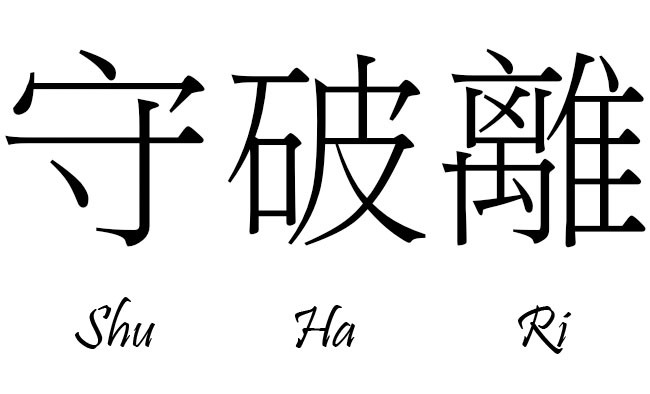
            Years ago Sensei posted a sign on the door going from the mens change room to the training floor it read simply….”SHU HA RI” and that was all, Hand written in black marker on a white paper. He did not really explain it to us, not that I was told, but it just sat their for a while every time we left the change room screaming “Look me up” at us. I think I was one of the few that went and found a book at the library that said something about it….this was before the internet…Yes I am that old….
            Shu Ha Ri stands for “Protect”, “Detach” and “Separate or leave”. It’s a very Martial arty philosophy that I have taken to guide my teaching and growing new instructors in our The idea behind Shu Ha Ri is that an instructor or student starts off learning the core priciples of a style. They study under a master/instructor for a long time and they come to understand and practice the core of a system. They grasp onto and covet the teachings of the instructor and they make the practice part of them. Then they student/instructor will move to detach themselves from the system and they will start to remove that which does not fit their personality and personal style as it has developed from exploring the system deeply. And finally they leave the system all together and show their personal style exclusively.
            This makes no sense to some who read this and think one of two things “its all just kicking and punching that makes no sense” or “why do they bother training in a system then make their own”…and while both seem valid…they just show the level of complexity of the Martial philosophy.
            Think of it this way….you enter a school to learn a trade or Musical instrument and KNOW NOTHING about how to use the tools of the trade. You study under a teacher and build your skills.  After a while you start digging around other ideas, skills or tools and start to build your personal skills and ideas. You work with trial and error and build up both your knowledge of the instrument/skill trade and find new ways to get to the same spot that seem to be more purposeful for you. After a while you can abandon the skill sand techniques that were taught to you and do your own thing…but your goals are still the same.
            To be more clear let me explain my walk through Massage school.  When I got to the school everyone told me I was a natural massage”er” and that I should get into it…but I had no skills really, I thought I had but I did not. I studied the techniques of the instructors I had and I practiced like crazy, studied books on anatomy and physiology and worked every day to getting better. I slowly began to master the strokes and compression techniques that the instructors taught me and I became very good at repeating the prescribed techniques that they taught.  This is the Shu part of the learning process.
            After a while I started watching Youtube videos and videos and experimenting with different things, but still working the traditional strokes and techniques. I practiced and merged different techniques together to try and get to the same outcome and then built off of this and started expanding my tool box. This is the Ha part of training. I was breaking from the traditional way that was taught to me and exploring a bit, but still keeping the traditions in mind.
            After I graduated and had a lot of practice I began to leave some of the traditional stuff behind, I hated doing some movements and found them unpleasant to do and less than impressed when I had them done on me. I took aspects of the traditional stuff and tossed it out the window.  I had transcended the old traditions and created a new style for my massage. And then it became tradition and I was back to Shu!
            So, how does this apply to teaching Karate?  When you start out teaching you should first look at what your instructor’s current style is. What art they teaching, how are they getting the message across and what do they focus on!  Then repeat it in classes, let that style set in but then try and add your own personal swerve on it. Begin looking around at others, implement changes to your system, your style and your techniques of communication. After a while you will notice that while you still hold the core values of what is being taught you are totally different than your instructor.
            Eventually you will find your style is now your tradition and at that point you should start exploring again, finding new ideas, new systems and new communication avenues and then bring that in to refresh the tradition and finally create a new one.

            In my current club we have about five different instructors who all teach a variety of classes. One of the things that I try and impart on the students is that they should try and train with as many different instructors in the club as possible because we all have our own point of view and styles for teaching. I try and tell the instructors that they need to be different from one another and not try to cover the same things the same way. Some are newer and still in the SHU phase of learning and teaching and look at me like I am crazy. Others are already in the curve of learning, adapting, changing and relearning and get it.


            What we are teaching may be very similar or even the same but how we teach it should always be our own ideas, our own views and our own ways of doing things. We will focus on different things and we will impart different ideas to what we are doing. That is the correct way to learn and teach martial arts. 

Monday, February 29, 2016

Karate and Occam’s razor.: Critical thinking in Karate applications from Kata.


                Occam’s razor is a problem solving principle that was penned by William of Ockham, an English Franciscan friar and scholastic philosopher and theologian who lived between 1287 and 1347.  Essentially the principle states “among competing hypothesis, the one with the fewest assumptions should be selected”.  So, what the hell does this have to do with Karate….a great deal if you are asking what a Kata interpretation or Bunkai is!
                In Science Occams Razor is used as a heuristic technique (Discovery tool) to guide scientists in the development of theoretical models, or rather…to use my own words it’s a way tool that scientists use to set up educated guesses about things they don’t have “proof” of.  It is not a result but a hypothesis as to outcomes. Ockham did not invent the theory, he just mastered its use. He also had some very important things to say about creation of multiple hypothesis around specific questions. He said “entities must not be multiplied beyond necessity”  or Don’t create to many hypothetical answers to a single question.
                So, again…what the heck does this have to do with Karate. Well take into account the number of Bunkai for each movement in kata. Some clubs teach nearly 20 Bunkai for each Kata move, its borderline ridiculous and most of them are far stretches from the plausible intent. But how to argue this without reverting to “I think its stupid cuz it is”. Well, Occam’s razor has an answer for this. First off you have to deal with the number of bunkai being spewn out by the “masters of bunkai creation” and let them know that multiple applications is not necessarily the best way to go, a few is okay, but 20 for a down block…well that’s excessive.
It’s important to also note that it’s not wrong, or stupid, it’s just a lot to learn and not the intent of bunkai training to be frank. However when teaching a standard class and introducing the idea of application to a student, its best to only focus on one or two applications per move. If you introduce more you tend to confuse a student and the strength of the work is limited. When learning Bunkai you should be shaving away the applications that don’t seem very applicable and don’t serve ton confuse the situation.
When I started Karate there was no Internet, we simply went about our day without cell phones and internet access and for Karate we actually had to go to the Dojo and train and listen to what the Sensei said, he told us what his instructor had told him, who was teaching what his instructor told him, along the way some personal insight was thrown in and the style grew a bit. But with the advent and implementation of cell phones and the internet ON cell phones I have seen the implementation of personal ideas into Bunkai Grow exponentially till its much like a competition to see who can create the most interesting, dynamic and completely different applications to show insight and creativeness and all it has served to do in my mind is create confusion with the students and an opportunity for some to thumb their nose at tradition and insight and kind of create a new dogma or ideology saying that they are right because they know better. Its bunk not bunkai!
Occam’s razor has gained a lot of notoriety in fields as far apart as mechanical engineering and theology, from medical deductions to astrophysics. And I use it in Karate a lot to try and figure out what is the best way to train, learn and teach specific ideas and movement skills, to interpret Kata bunkai and to expand my understanding of human movement and interactions in dynamic movement. The scary part is not that there is a huge amount of variation in Karate and movements skills, it’s the lack of thought and analysis that goes into a personas approach to Karate. People tend not to be practical or pragmatic when it comes to Karate and movement skills, they see out fancy and ineffective movements and replace the simple and effective with them.  If a student were to use the razor in their though process then they would see that often, not all the time, the fancy moves they throw or the crazy applications they come up with are a hindrance, not a help.
                One thing that the razor does that ticks off Karate people is that it does not state that your application is WRONG, it’s says it’s not likely to work, or less likely to work in real life as opposed to this other application. That’s is simply something that Karate people don’t get. The thing in Karate is one master will offer up their “understanding” of a Bunkai and then the other will come along and say “No, that’s crap, the application is this”! and there you have the black and white approach to Karate. The Razor suggests that there are multiple “correct” ways for something to be used, but that one is “more right” than another…now you just lost 90% of black belts! They were taught yes and no, right and wrong…not right and left sometimes but right and wrong for sure…and the answer is that they are right…ergo everyone else is wrong…or was that Ego?
                Now like some well-known “anti-Razor” philosophers I will admit that some of the Bunkai I have seen would make me say “even if they are not true, they are well conceived”.  Getting down to brass tacks, when you do a Kata you should be looking for a few applications you can use to identify what you are doing….my suggestion is to get a partner and a good senior or instructor and go over your ideas, see if they work, to what degree to they work and can you replicate them easily? If so, they have passed the Karate version of the Occam’s razor.


Tuesday, December 29, 2015

The Basic Rules and regulations of the JKA of Manitoba; a rather incomplete guide!

The Basic Rules and regulations of the JKA of Manitoba; a rather incomplete guide!
 
                It’s been pointed out to me over the last few weeks that some people don’t know the proper etiquette in a Dojo. I mean they get that it’s a special place and you can’t act like you do in the outside world, but one of the junior instructors said that students do not understand we have some specific rules they have to follow, despite us trying our best to let them know that we have some specific rules, people ignore some, fain ignorance on some and just plain break other rules of etiquette in the clubs.
                We don’t really have a lot of rules that we cannot bend in the JKA/MB but we do have some very specific rules that should be followed. Here is my take on the rules we need to enforce and why…and which can be “bent”….
 
Going on and off the floor
                When a student enters the training area or leaves it is proper to bow towards he Kimaza to show respect for the training area, the instructors in the club and the students who will help you learn.
 
Arriving late
                If at all possible it is suggested that you don’t arrive late, but if you do you should sit in Seiza at the entrance of the training area, preferably off the floor but your instructor must be able to see you. Raise your hand to call attention to yourself. The instructor will call you to join class when he is ready to have you safely join.
 
Lining up
                When you are called to line up, do so quickly and according to rank. If students are both the same rank or the same belt color and you don’t know who is higher just fit into the line anyplace that is appropriate.  Not moving quickly makes this process take longer than it should and takes time away from training.
 
No talking in class
                Once class starts it is important to hear instructions and details on what you are doing. For safety reasons you need to know exactly what is expected of you and those around you. Talking and not paying attention could lead to issues and injury. Also you will miss out on what you are doing and the instructor may have to repeat themselves.
 
No jewelry, watches, earrings, rings. Tape those that don’t come off.
                NO jewelry when training. Any rings that cannot come up must be taped well and any Medical alert bracelets must be taped as well. NO necklaces or earrings. If earrings cannot come out they MUST be taped to support them from being caught on anything and causing injury!
                I had someone fight me on this one once; she said she had a right to keep her ear ring in when training and it was her body. It told her the two stories of people wearing ear ring in training I was part of. One was a stud earing that got imbedded in the bone behind the ear (mastoid) when a person was kicked accidentally and I had to remove the stud from the bone with a pair of needle nosed plyers. The second was an earlobe that was ripped off when an ear ring caught on a person’s Gi, if they still want to wear the earing have them wright a note saying they won’t sue and they take personal responsibility for the ear ring.
 
No chew gum or have candy or food in the mouth while training.
                Eating or chewing gum, candy while training is a great way to encourage choking. We don’t allow people to eat or have candy on the DOJO floor because of safety concerns.  Not only can someone choke on the gum or food, but if it falls out of your mouth or if you spill, drop it, we get the honor of walking in it. NOT COOL. If the “galley” for watching students is on the dojo floor as it is with one of our clubs we also don’t let people eat in the galley area.
 
Karate students must follow the instructions of their seniors and instructors, quickly and respectfully.
                When an instructor or senior asks you to do something in the club, like move to a different spot, or give a command to line up you should do so quickly and quietly. This is something I stress to student because it helps us run an efficient and effective class, however I had one student say “I am paying for this class so I will move when I want to”, I told him that was fine, and he could move out of class and come back with a better attitude or not at all. Some fail to realize that half of the orders we give are to ensure everyone has a good class and the other half is for your safety. One more thing…you are not the only one paying for the class, the other 20 people waiting for you to smarten up have paid for this class as well, so if you don’t want to listen, the door does open to let you out.
 
When changing positions in the dojo, do not walk through the rows. As much as possible, walk around the outside or between rows.
                Its funny, half of the accidents I see in the dojo are from people running “between lines” and trying to make it out of the way of oncoming traffic. When you move in the Dojo make sure you do so in a way that gets you out of harms way and not like a character in Frogger!
 
When adjusting or tidying your gi, bow and face away from the dojo shrine. Do not adjust your gi during an exercise unless told to do so.
                Its one thing to pull at the bottom of your jacket and correct a rising up issue, its another to take your belt off and fix yourself up in the middle of Kumite ext. The most extreme form of this I saw was a guy who took his Obi off and adjusted his pants right there on the Dojo floor, we saw every wrinkle and mole he had on his upper torso and while he may not have body issues, and was very open…others were uncomfortable. I have also seen ladies do a similar thing with a sport bra on, again…while you don’t have issues…most of us would feel uncomfortable to say the least.
 
Karate students must have the instructor's permission to leave class before it has ended..
                One of my pet peeves as an instructor is when people go missing during a class…..especially a very hard one! I tend to watch and see if students are looking a tad green and then if they are missing I will go looking for them. If you feel ill don’t leave class, sit next to the garbage in case of you getting sick, but don’t leave. I have had one student leave class and pass out in the girls bathroom….it was far more scary for me than her! A rule, if its just a pee break…let me know and realize if you are gone for longer than normal…someone is going to come looking for you.
 
Say OUS when asked a question
                “Ous” is a strange word that take students a while to get used to. There are many stories about what Ous means or where it came from…and none of them really matter. The use of this affirmative term shortens the use of talking in the dojo and thus adds to training time. Keep this in mind when being asked questions. If you know or will do what is asked “ous” the person….or “oos” depending on who you ask. If you do not want to answer in the affirmative then just say no…someone will ask you why no and you are good.
 
Care for your Gi and obi
                I cannot state how important it is enough to keep your Gi clean. Obi’s will fall apart, but dirty, torn up Gis should be cleaned or replaced. Not only is it gross to have to smell someone else’s stench, especially if its week old pizza sauce that is molding on your Gi pants, or to spar with someone that is filthy…but holes in gis and ripped parts are weak and can be torn more or lead to injury…or over exposure. It also shows a complete lack of pride to have a Gi that is so filthy that its horrible to be near that person.
 
What can I put on my gi/Obi
                A patch over your left chest, nothing more unless its your name written on the pants and jacket….lower down on the jacket and up high on the pants. The point being that it’s as clear of stuff as possible. I have seen some pretty funny Gi’s with patches all over the place in my time, they look cluttered and horrible to me. I have seen Gi pants so done up with patches that the pants barely bend! JKA rules are basically to be as minimalistic as possible.
 
Sensei, sempai or what?
                Perhaps the most confusing part for new students, but should be the most clear cut for seniors. When you first join you only really need to know who the instructor is…that’s “Sensei”…the rest are “Sempai” but we forgive you if you call us by our first names or Mr/Mrs., and personally I don’t mind if you call me anything that is not an insult right off. However as you go up in levels you realize who is who and you should use that title in any environment that is appropriate unless corrected not to.
                My rule of thumb is similar to my bowing rule of thumb, when in doubt…use the title you think they are (I always call black belts Sensei unless I find out they are lower rank or equal to me…or not an instructor). Respect is key…that’s the most important part.
 
Who to bow to?Bow to Sensei!
                Much like the use of titles in the Dojo, bow to EVERYONE. It’s not rude to bow to a junior, try to figure out who you are to bow to can be insane and difficult. Remember that bowing is much like hand shaking, one is enough per person and make sure you just bow when you feel it would be polite, when you think it appropriate…oh, heck just bow and everyone will know you are trying.
                It is especially important to bow to Dingman Sensei and the seniors in the association. They have created the format and frame work that you are training in. its only respectful to bow to them and let them know you appreciate it.
 
Cleaning up
                Cleaning up after a workout normally means running a wet rag across the floor to clean it of perspiration and any other fluids (I mean blood) that may be on the floor. Over the years it has become less and less understood. To put it plane it basically is a way of showing respect to the next class that comes along. If you note a senior is not doing the floor, chances are they will be mopping up, dusting or vacuuming the club after you leave, don’t worry as you get up in rank your responsibility grows, it does not diminish.
 
What if you don’t show up for a while?
                Okay, here is the deal….some instructors will say its horrible because they rely on your funds to keep the doors open, For me I say that’s crap. Yes they do rely on your funds to keep the doors open and to earn a wage, but its also their responsibility to draw in more students so they can afford to keep the doors open. For me it’s the lack of upward mobility you get when you are off for a while. We care, or should care about you and your progress in Karate, time off means lost learning time and a slide back in what you retain. Just think of just about getting to a rank, taking three weeks off and starting from scratch. My only concern if you are off for a while or planning a vacation from the Dojo, let me know so I am not worried you got hurt or something.
 
Use of inappropriate Language
                I swear A LOT…ask my wife and mom…I swear to much…ask my sister and Dad….And when I swear its often ear burning and can be offensive at times…ask any of my friends or extended family…but to be frank…I don’t think I have ever sworn in a Dojo in my life! The Dojo is not the right place to use swears or inappropriate language. I recall one senior making comments about a student and commenting on his thoughts on her “physique”…..TOTALLY in what you should be doing in the club. The Dojo to me is much like church, behave the way you would think acceptable in a Church and be on your best behavior. Don’t comment on inappropriate things and don’t swear or use any kind of language that may be offensive. I try my best, but the odd “Damn” will slip out…but nothing to blue! Oh, and I get embarrassed saying Butt or bumb!
 
No fighting in the dojo,
                I would love to say that this is a no brainer, but in the last 37 years I have seen at least 6 real fights in the dojo from meat heads that don’t realize its not a Testosterone match!  If you start to take it personally walk away, if the person won’t stop, go to the instructor.
 
No spitting or No lying about
                Again, some may say that this is a no brainer, but I have seen people laying around the club…kids mostly…a lot, and on the odd occasion I have seen people spit on the floor. Its GROSS and it happens. Treat the Dojo well and you can learn their, learn respect and proper attitude. Treat it poorly and you are showing you are not learning anything.
 
Keep your nails short and trimmed, CLEAN feet ext
                I have had two times were NAIL CLAWS have racked me up and damaged my shins or almost cut my wrists….its not pretty and strangely its not the ladies that have done this…no they generally just stomp my big toe and rip my own nails off. It’s the men! They don’t cut their toe claws and then I get shin scrapes and cuts and I HATE THAT.  Cut your nails.
                Also, stinky, dirty feet gross me out, and Im not alone. If I cannot stand next to you for fear my eyes may water…wash them! Also, when you lift your feet up and they are dirty before you come on the floor…you better…wait…you guessed it…wash them. Same goes for other hygiene things. Clean hair, nails trimmed, not smelling like you have not changed your Gi or washed it in a month…not helping your cause to stay on the floor.
 
Proper safety gear in good shape. Safety string for glasses
                My favorite conversation with students “do you have the safety gear….” , them….”yes!”….me “put it on”!!!...them “its at home!”….Me…”So you don’t have the safety gear…”. Its one thing to have the safety gear, its another to bring it with you. Each student needs to have proper hand pads and mouth guards at all time and any other safety gear that you need, like strings for glasses…especially those made with glass lenses.
 
No Shoes in the Dojo
                Again, you would think this common sense, please don’t walk on our training floors with your shoes so we get to walk on your dirty left overs with our bare feet! Common sense but I have seen people with winter boots on walk out on a beautiful hard wood floor and track muck, sand and salt onto the floor and we have had to mop it up! I have also seen dog poop tracked onto a floor in a Community center by a parent that was not careful in what they stepped then argued that they did not know…but they still walked on the gym floor with their shoes on, had they taken them off we would not have had an issue….well much of one.
 
 
Anyways, that’s pretty much the rules and I hope they make sense! As you can tell 99% of the rules we have are just common sense and the key thread in any and all of them is that respect factor.  

Implementation of Strategy…or the Tactics that fulfil a strategy


   So a strategy is an overall “Game Plan” for a situation, be it how to take back Europe from the Nazi’s or how to face a big Monster in a Kumite Match! So, what then is a tactic and how does it apply? Tactics are those drills, the combinations or the techniques that drive the strategy to success. 
                We train Tactics all the time in Class, in fact I would venture that not a single Karate class is run without the use of training in tactics. Step in punch, step in kick, throw a round house kick/ back fist combo and you are performing tactics. The use of physical movement to advance or counter is use of a tactic.  But it’s also not that easy. A technique is only a tactic if its used in conjunction with an overall strategy, and most of the time we are doing this subconsciously or without actually viewing it this way.
                Most students do “Flail to not fail” Karate. They don’t look for a target, they don’t think of follow up moves, they simply throw an arm or leg at an opponent and pray it lands. In sport Karate this is fine, they tend not to think beyond “Throw it and pray” kind of tactics anyways, but in Goshindo or Budo based Karate one has to think like Chess when fighting, what is the move that will flow this attack or defense….how can I draw them into doing what I want….how can I react to a particular strategy to turn it in my favor.?  All these are true Budo reactions and use of strategy. Now the implementation of  the answers is tactical applications of Karate.
                So, the tactical side of Karate is the actual use of techniques used properly against proper targets to meet the needs of the situation and enforce the strategy you have come up with. Now, practicing  good Mawashi Geri on a punching bag IS part of this. You need sharp weapons and you need to be able to “hard wire” yourself to use them at a minutes notice so you can apply them and work your strategy. Practice makes perfect after all, but you also need to have a pliable mind and be able to change tactics to adjust to situational shifting. This is often called “regrouping” Mentally.
                My favorite tactic is to counter punch with a strong Reverse punch when I am faced with a faster person and when faced with a slower or less experienced partner I tend to do my “California blitz” and go for it…if you don’t know what that is…I’m not telling because I may have to use it on you! I practice both moves a lot so I can pull them out at a seconds notice. I tend not to block to much, more just a push to the attack and blast the opponent.  I also don’t do sport Karate so Im not going for a fancy point…its ugly and not a great strategy if I want to be a model. I tend to catch a fist in the face or chest, but I know my punch has better accuracy and power and my redirection drains the power from the original punch…so in a case of power vs power…I win.
 
                Now, back to Dingman Sensei and his fight with Mr. Muller, The strategy was in place…break rhythm, use speed to win and get inside his power zone.  What tactic did Dingman Sensei use to address the Strategy?  He broke the rhythm using his “Dingman Duck” its not a real duck…its when you lead with a leg far out and sneak inside, you use hip motion with most of your weight on your back leg while your front leg sneaks forwards. Its damn Dangerous if you are facing a guy that sweeps a lot but Mr Muller did not do much of that because his size let him avoid that need. Using the up and down bouncing and the “Dingman Duck” he both got inside and broke up the rhythm of Mr. Muller. The shifting around slowed Mr. Muller down as well because he knew Sensei was faster so he kind of planted his weight and thought he would out wait the smaller foe and then just counter…now Sensei had a immobile target.
                Sensei found himself inside Mr. Mullers power zone really fast and he had established a bad rhythm for Mr. Muller and now all he had to do was use a different tactic to score the point.  Keep in mind Sensei was still about three to four feet away and Mr. Muller could rush forwards at any time….But he was sitting stable for the time being. Sensei needed a Ippon or the dance would start all over again and he would need a new strategy or set of tactics so Mr. Muller would not catch on. So, what to do?
                Sensei knew a Ippon would only come if Muller was struck (Sondom people…not a real strike but close) in a spot that he was not defending that would show his complete loss. THE FACE!  Sensei finally set his weight on the back foot, pushed off and rushed inside the three foot area and leapt up. He put his back leg on Mullers extended front leg and pushed so he was now running up Mullers leg to get the right distance and BLAM he shot out a solid straight punch that would have taken Mullers nose off  his face if he had landed it for real and he Kiai’d to show the emphasis on his success in landing the perfect punch, totally surprising the opponent and I can only imagine the ring refs surprise as well!
                The implementation of his strategy and the tactics he used won Sensei a battle in a tournament that NO ONE thought he could win against an opponent that was nearly two feet taller than him and way bigger than he was. The referee called for an Ippon as Muller had his hands low and had not moved at all as the smaller man rushed up him.
 
                Studying Karate with strategy and tactics in mind will not only make things a bit more clear but it will also make your karate more applicable in situations when you really need them. My true thoughts on this is that you must train tactics so they are second nature….use of specific moves and drills will help you in any situation if you can use them with very little thought. Then putting the use of strategy into the training will help you get ready and even asses specific situations so you can then be more effective in them.
                When teaching I am now working on implementing both these ideas and tools into training brown and black belts and putting names to them as Dingman Sensei tended to be more traditional and not name them, but he did teach us this way for years. A student should learn the whys and not just the how’s and they should not just dance in the Dojo with different techniques. They should know why they are doing something, how to do it and the bigger pictures of Strategy and Tactics.

Strategy and its development and use in Karate.


                Strategy has a broad scope and its not “Right now” or minute by minute kind of thinking. Its more along the lines of setting specific goals, without setting up how to get there. By specific goals it means a good strategy would NOT be setting a goal like “I want to win” it’s a lot more defined than this, its more “I will off win if I use explosive moves as the defender does not respond well to shifting in speeds and timing”.

                Thinking of it in military terms often helps with a basic understanding. A strategy to win WWII was to take the beaches in France. The Generals all got together and made strategies on a BIG map of Europe and they said “we need to land in France, move to the boarders and then push back the Germans while Russia kept them busy fighting in Russia. Then some lower level guys were given their order “Take the beaches then push towards Germany”. Then the lower level guys had to find tactical ways to take the beaches. As we know from history we lost a tone of hero’s on those beaches implementing the tactics to work the strategy of the Generals.

                In order to have a successful run as a Kumite Competitor or to have good skill as a fighter you need to have a few things. First you need to be strategically thinking all the time. Find the best routes to win a match or take advantage in Dojo Kumite. Is your opponent faster than you,  Maybe more powerful but slower, Doe they seem to bounce a lot on their feet or are they set firm on the floor. Do they have more experience than you or are they Raw and new to Jiyu Kumite?  All these are fantastic first steps for your strategy development. You need to assess your opponent right away. I have sparred with COUNTLES guys that all have different skill sets that I have to be aware of when doing Kumite.

                So, now you kind of know what you are facing, the guy is say slower but much more powerful and has great punching, but his kicks are slow and low. He has a tone more experience than you and better timing. So, strategy development now means that you need to find the weakness that you want to exploit and work around other barriers that will throw you off. So, in this case you want to be faster, throw off his rhythm by shifting yours around to confuse him. You don’t need to  worry to much about high kicks but you do need to keep in mind that his timing means he may have great foot sweeps. You want to keep outside his punching distance till you are ready to jut in and then out again. So the strategy is “Broken timing-Speed and distance variation-explosive moves and use of longer range fast attacks”. 

                Or, you are facing a faster fighter, he bounces a lot on his feet and his center of gravity is higher than yours and he uses a lot of high kicks. He is not as experienced as you and throws techniques without a proper target selection. Okay, so tactics will be to possibly stay inside his kicking range so he has to use his hands to fight, slow down the fighting with use of pressure on the fighter and wait till he lifts his hips/center of gravity and ashi barai the guy till he falls like a tree! Then pounce and finish him off.

                Both of these are strategies that may or may not work depending on who the other guy works his strategy but you would never do the complete opposite of these and say stay in kicking range and try to out kick a quicker longer and more explosive kicker or try and stay in the pocket with a power puncher who has better timing….unless being unconscious is your actual goal!

                Sadly we don’t do a lot of strategy work in Karate, We tend to train mostly in tactics, which I will get to shortly. We miss opportunity to “Game plan” or do some basic “how to” work, unless we are training in Goshindo style work and then its “what would you do if a big guy grabbed you from behind” or “If a guy swings a club at you this way what would you do”….even then we end up going right to tactics and miss out on strategy.

                A good strategy has a mental aspect of a big version of what and a very distinct understanding of WHY. We did not just decide that storming the beaches was a good idea because we fancied the beach  as a nice spot to land, their was a good why involved, just like we say “we will sweep at the legs and get the guy when he is off balance” because the guy will fall and be on the ground, shocked for a second so our second attack will finish him off.

                Also, because of a lack of strategy most people panic when they fight against someone they feel is bigger and stronger or faster and more athletic. I remember a story that Sensei Dingman told me about his fight with Mr. Muller. Sensei is not a big man, about five two or three and he was always about 120.So he was tiny compared to Mr. Mullers near seven feet tall and probably 250! The guy was a beast and Sensei had to face him down. The only words that Yaguchi Sensei had told Sensei Dingman was “beat him” and that was the strategy his instructor…the best Kumite coach in the world gave him for that fight!

                However, Sensei Yaguchi…being the best Kumite coach that the JKA had produced had taught sensei about Strategy. Sensei told me he knew that Muller was slower, longer, had exceptional timing and used his length to keep the attackers on the tip of his kicking and punching zone. Sensei knew to beat Muller he had to break this all down, use his speed and explosiveness to beat the distance, create a situation where Muller was uncomfortable and throw him off so his timing was off.  That was the strategy!

                Dingman Sensei then went and created some tactics to implement, pretty much on the fly. Dingman Sensei has always been better at using and developing strategy to counter others strengths and use his own to his advantage and then implementing tactics he had been training in or making up on the fly. He is a master’s master at this as an athlete and tried to teach this to everyone he coached.